
Inside BENEO’s new pulse plant: pioneering sustainable protein from faba beans
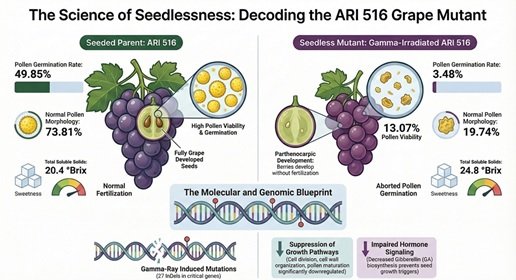
Seedless grapes are increasingly in demand globally for both fresh consumption and processed products such as raisins and juices
Scientists have uncovered key genetic and developmental mechanisms underlying seed-lessness in grapes, a trait highly valued by consumers and the grape industry worldwide. Grapes are among the most important horticultural crops globally, with a large share of production consumed as fresh fruit or dried products such as raisins. Consumer preference strongly favours seedless grapes with thin skin, sweet taste, and good texture, making seedlessness a highly desirable trait in breeding programmes.
Seedless grapes are increasingly in demand globally for both fresh consumption and processed products such as raisins and juices. However, despite their popularity, the biological mechanisms controlling seed development and seedlessness in grapevine have remained only partially understood.
The research by Agharkar Research Institute (ARI), Pune, an autonomous institute under the Department of Science and Technology (DST), Government of India along with collaboration with Savitribai Phule Pune University, provides new insights into the molecular and genomic basis of pollen sterility leading to seedless grape formation This could help breeders develop improved seedless grape varieties with better yield and quality.
The study recently published in BMC Plant Biology, investigated a seedless mutant derived from the high-yielding grape cultivar ARI-516, developed at the institute.
The research team headed by Dr Ravindra Patil conducted a detailed comparative study of the seeded grape variety ARI-516 and its seedless mutant to identify the developmental and genetic changes underlying the seedless trait. Through microscopic examination of reproductive tissues, researchers observed that the seedless mutant exhibited abnormal pollen morphology, very low pollen viability, and a complete inability of pollen grains to germinate, indicating pollen sterility as a key factor in seedlessness. Further anatomical studies revealed that the female reproductive structures (macrogametophytes) in the mutant plants were significantly smaller than those in the seeded parent variety. These abnormalities disrupt the fertilization process, ultimately leading to the formation of seedless berries.
To uncover the underlying molecular mechanisms, the scientists performed transcriptomic analysis (RNA sequencing) at multiple stages of flower and berry development. The results showed that several genes involved in male gametophyte development, pollen maturation, cell division, and hormone signalling pathways were significantly downregulated in the seedless mutant. The research also employed whole-genome sequencing to detect genetic variations between the seeded and seedless plants. The analysis identified multiple insertion–deletion mutations (InDels) in genes associated with pollen development. These mutations are likely to disrupt normal pollen formation and function, resulting in pollen sterility and subsequent seedless fruit development.
According to the researchers, the combined genomic and transcriptomic evidence suggests that the seedless phenotype in the mutant grapevine arises through parthenocarpy, a process in which fruit develops without fertilization due to defects in pollen formation and reproductive development.
The study represents one of the most comprehensive efforts to understand parthenocarpic seedlessness in grapes using modern genomic tools. Identifying the genes associated with pollen sterility and seedlessness can provide valuable molecular markers for grape breeding programmes. Such knowledge can significantly accelerate the development of new seedless grape varieties with improved fruit quality, yield, and adaptability, benefiting grape growers and the horticulture sector.