
Inside BENEO’s new pulse plant: pioneering sustainable protein from faba beans
Gen Z is placing greater emphasis on protein as part of daily intake, with consumption levels growing at over twice the global average
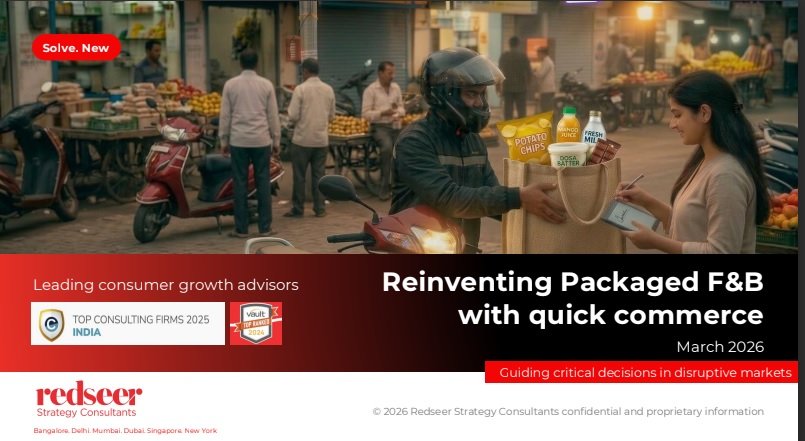
Redseer, a strategy consulting firm, in its latest report, ‘Reinventing Packaged F&B with Quick Commerce,’ highlights that India’s packaged food and beverages market is entering a new phase of growth, projected to expand to ~$150 billion+ by 2030 from ~$100 billion. Within this evolving landscape, the quick commerce channel alone is expected to scale from $4 billion today to more than $25 billion in GMV by 2030, driven by rising demand for speed, convenience, and high-frequency consumption.
Quick commerce has moved well beyond being a last-minute fulfilment channel. With 50 million+ monthly users across more than 250 cities, it is beginning to influence everyday purchase behaviour. Its share in the packaged F&B market is expected to rise from about 4 per cent today to nearly 15-20 per cent by 2030, growing significantly faster than other formats and steadily taking share from them.
At the same time, consumers are becoming more deliberate in their choices. Gen Z is placing greater emphasis on protein as part of daily intake, with consumption levels growing at over twice the global average. Millennials are reading labels more closely and are willing to pay a premium for products that are perceived to be cleaner and better for them. This nutrition-oriented behaviour in metros is also being replicated in Bharat, wherein households are steadily increasing protein consumption, with paneer, soya, and sprouts becoming more common in weekly diets. There is also a demonstrable shift towards reducing refined sugar and oil, with a growing disposition to adopt alternatives.
“Quick commerce is emerging as a structural force in the packaged food and beverages market, driven by its ability to capture demand at the point of intent,” said Mrigank Gutgutia, Partner, Redseer Strategy Consultants. “What was once seen primarily as a distribution channel is now starting to shape category strategy, innovation priorities, and investment decisions across the ecosystem. For brands, operators, and investors, this marks a fundamental
shift in how growth will increasingly be built and realised.”
These changes are showing up clearly in the ready-to-cook segment. Smaller households and time constraints are pushing consumers towards solutions that are easy to prepare and portion-controlled. The rise in appliance ownership, including microwaves and air fryers, has further improved usability. At the same time, quick commerce has reduced the need for advance planning. Meals are often decided closer to consumption, supported by delivery timelines of 10 to 15 minutes. Driven by these factors, the frozen RTC category on quick commerce is already estimated at around $375 million, while chilled segments such as batters, at roughly $400 million, have seen deeper penetration given their shorter shelf life and higher frequency of purchase.
Kushal Bhatnagar, Associate Partner, Redseer Strategy Consultants, added, “Quick commerce is fundamentally changing how consumption occasions are formed. The same consumer is now solving for convenience, health, and indulgence within a single order, often within a 10-to-15-minute window. This has direct implications for assortment, visibility, and even pricing. Categories such as ready-to-cook, functional beverages, and chocolates are responding differently because the underlying need states are different. The brands that win here will be the ones that understand these micro-moments and build for frequency, not just scale.”
Health is emerging as another strong lever of growth, particularly in the beverages space. Functional drinks, protein-infused beverages, and categories such as packaged coconut water are gaining traction. Quick commerce is playing a role in enabling trial and repeat. India’s per capita consumption in non-alcoholic ready-to-drink beverages remains below global benchmarks, which leaves considerable headroom for growth. The core growth in India in the beverages category would be driven by better-for-you and functional beverages. Even within coconut water, while fresh consumption continues to dominate, packaged formats are expanding, with over 20 per cent of sales already coming through quick commerce.
Indulgence is evolving as well, particularly in chocolates. 50 per cent of the incremental growth in the category between 2024 and 2025 has come from quick commerce, and 10% of all chocolates sold in India were through Quick commerce. A meaningful share of demand is concentrated in late evening hours, especially between 9 PM and midnight. These purchases are largely impulse-driven and linked to self-reward occasions. Higher average selling prices during these time windows indicate a lower sensitivity to price in such moments.
As quick commerce continues to scale and consumer preferences continue to evolve, the packaged F&B market is likely to see steady shifts in both category mix and channel share. Growth from here will be closely tied to how well brands align with these emerging consumption patterns.