
Inside BENEO’s new pulse plant: pioneering sustainable protein from faba beans
Chef Arjyo Banerjee, Chief Culinary Officer, Compass Group India
Food waste is no longer a side conversation. It sits at the intersection of climate risk, economic loss, and food insecurity. As per the Food and Agriculture Organisation, nearly one-third of all food produced is lost or wasted globally. At the same time, food waste contributes to 8 to 10 percent of global greenhouse gas emissions (United Nations Environment Programme).
India reflects this paradox sharply. We generate an estimated 68 to 78 million tonnes of food waste each year (UNEP Food Waste Index Report 2021), even as access to nutritious food remains uneven. Add to this the fact that almost 45 percent of fruits and vegetables never get consumed globally, and the scale of inefficiency becomes hard to ignore.
This is what makes Stop Food Waste Day, now in its 10th year, especially relevant. What began as an initiative by Compass Group in 2017 has grown into a global movement. More importantly, it signals a shift. Awareness alone is no longer enough. The conversation is now about measurable action.
From Awareness to Action: Where Is Real Change Happening at Scale?
The real question is not whether we understand the problem. It is where change is actually happening at scale.
Workplace dining and institutional kitchens are emerging as unlikely but powerful solution spaces. These environments operate within structured systems. Demand is more predictable. Procurement is centralised. Consumption patterns are visible. That creates the conditions needed to move from intent to accountability.
In India, this scale is significant. Large foodservice operators serve over a million meals a day across hundreds of sites. This is not just about feeding people. It is about influencing how food is produced, consumed, and valued everyday.
Designing Smarter Kitchens: How Technology Is Turning Insight into Impact
If there is one shift that is quietly transforming kitchens, it is the move from instinct to insight.
Technology is enabling kitchens to become predictive rather than reactive. AI-led demand forecasting helps reduce overproduction, which remains one of the biggest drivers of food waste in food service (UNEP). Waste tracking systems go a step further. They identify exactly where waste occurs, whether at preparation, service, or plate level, allowing teams to respond with precision.
At Compass Group India, this is supported by AI-powered solutions such as Annmatra, which capture and categorise food waste in real time, generating actionable insights at the kitchen level. The outcome is not just visibility but accountability.
Research indicates that data-led interventions can reduce food waste by up to 40 to 50 percent in commercial kitchens (World Resources Institute). That is the difference between incremental improvement and systemic change.
Menus, too, are evolving. Data-backed menu engineering ensures that what is prepared aligns more closely with what is consumed. Over time, this creates kitchens that learn and adapt continuously.
Rethinking Waste: How Repurposing Is Unlocking Value in Everyday Kitchens
Even with better forecasting, some degree of surplus is inevitable. The question is what we do with it.
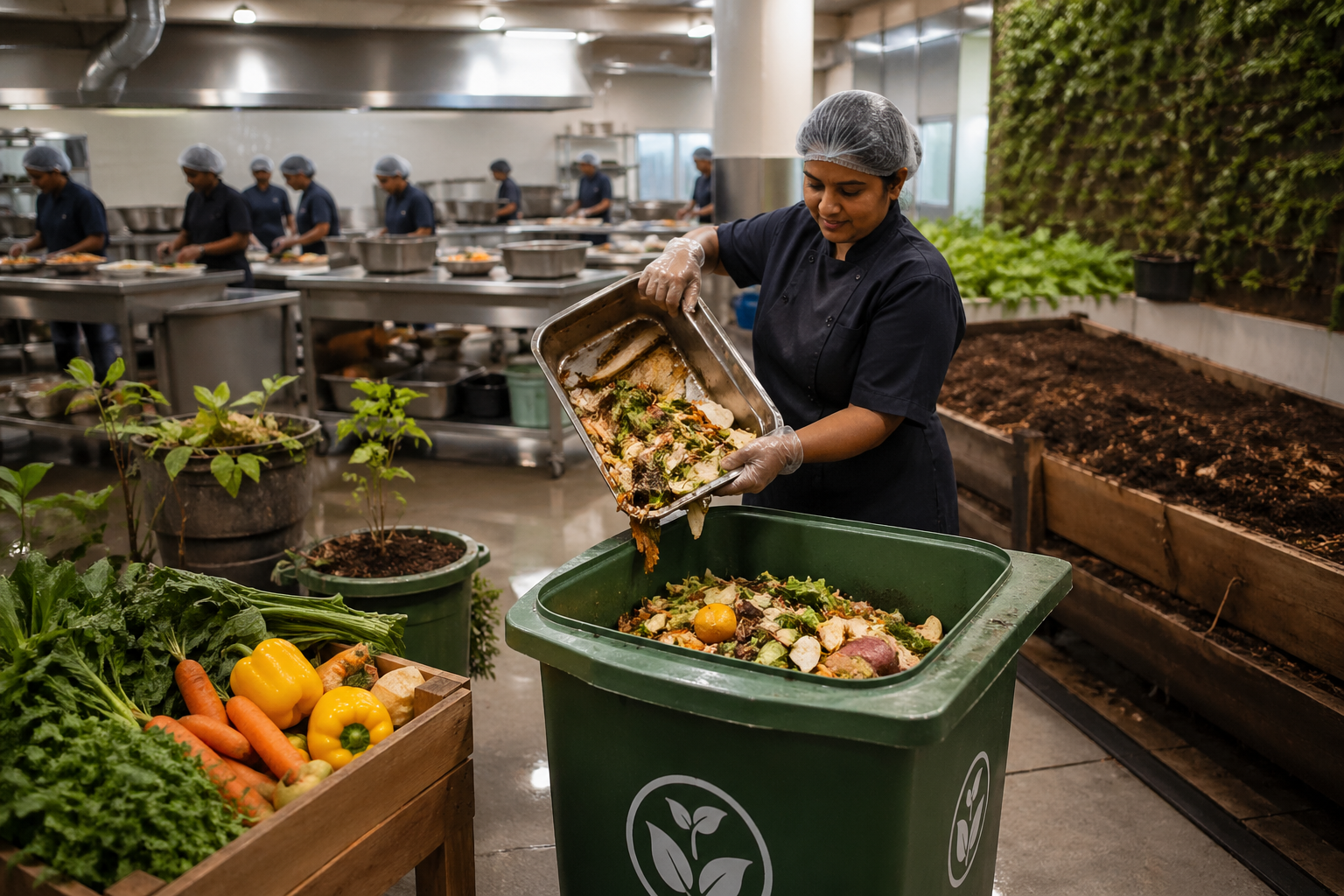
This is where the idea of repurposing comes in. Not as a compromise, but as a creative and nutritional opportunity. Through initiatives like the Food Repurpose Program, everyday kitchen by-products are being reimagined and are given a second chance to really transform. Vegetable peels become chutneys and vegetable dusts. Trimmings are transformed into broths and stocks. Even coffee grounds find secondary applications in kitchen gardens. At Compass India, over 150 chef-curated repurpose recipes, combined with an AI-powered food waste tracking system, are transforming how India’s largest workplaces think about food. In many cases, this integrated approach has delivered measurable impact like the creation of ~730 tonnes of sustainable dishes, demonstrating how waste can be meaningfully reduced while creating both environmental and operational value.
What often gets discarded still carries significant nutritional value, including fibre and essential micronutrients. Considering that 45 percent of fruits and vegetables are wasted globally, the opportunity to recover value is immense.
Equally important is the behavioural shift this drives. Chef-led experiences such as interactive tables and zero-waste workshops bring these ideas closer to consumers. They move the conversation from the kitchen to the plate, and eventually into homes.
The New Economics of Food: Why Reducing Waste Is Good for Business…..and the Future
Reducing food waste is not just an environmental imperative. It makes strong business sense.
A study by the World Economic Forum shows that for every dollar invested in food waste reduction, businesses can see returns of up to 14 dollars. Lower waste translates into better cost control, improved procurement efficiency, and stronger margins.
At the same time, ESG commitments are becoming central to business strategy. Food systems sit at the heart of this. Organisations are under increasing pressure to demonstrate measurable sustainability outcomes.
Then there is the consumer. Today’s workforce is more aware, more informed, and more conscious of what they consume. Workplace dining is no longer just about convenience. It is a daily touchpoint that can shape behaviour at scale.
The Quiet Transformation Powering Tomorrow’s Food Systems
Workplace kitchens may not always be visible in the broader sustainability conversation, but their impact is undeniable. They sit at a unique intersection of scale, structure, and influence.
As technology, culinary innovation, and consumer awareness come together, the opportunity is clear. We can move from a system that manages waste to one that actively prevents it.
The future of food will not be defined by how much we produce, but by how thoughtfully we use what we already have.