
Inside BENEO’s new pulse plant: pioneering sustainable protein from faba beans

The Department of Food and Public Distribution, under the Ministry of Consumer Affairs, Food & Public Distribution, has amended the Vegetable Oil Products, Production and Availability (Regulation) Order, 2011 (VOPPA Order) or better known as VOPPA Order 2025, to prevent enhance food safety.
India is the largest consumer and importer of edible oils, which consist of palm, mustard, soybean, sunflower, rice bran, groundnut, and coconut, among others. While palm oil is mostly imported from Indonesia and Malaysia, soybeans are imported from Argentina and Brazil. Sunflower oil is imported from Ukraine and Russia. Mustard, groundnut, sesame, and other seeds are mostly grown in India.
According to a report in PIB titled ‘Pathways and Strategies for Accelerating Growth in Edible Oils Towards the Goal of Atmanirbharta,’ over the past decades, per capita consumption of edible oil in the country has seen a dramatic rise, reaching 19.7 kg/year. This surge in demand has significantly outpaced domestic production, leading to a heavy reliance on imports to meet both domestic and industrial needs.
Any fluctuation in its price directly impacts household budgets, particularly those of the poor and middle class.
Amidst all the talks to enhance production, a rising demand, there has been reports of edible oil adulteration and blending in India. A significant and ongoing concern that poses serious health risks and economic fraud issues.
Reports on the Food Safety and Drug Administration conducting raids at Gayatri Oil Industry in Fazalgang near Kanpur, seizing approximately 35,727 litres of edible oil worth Rs 53 lakhs due to suspicious samples, is nothing new.
The Department of Food and Public Distribution, under the Ministry of Consumer Affairs, Food & Public Distribution, to tackle the menace, has notified a key amendment to the Vegetable Oil Products, Production and Availability (Regulation) Order, 2011 (VOPPA Order).
It can be noted that the edible world sector has suffered from the absence of real time and reliable data on production, imports and stock positions. The lack of visibility often leads to price volatility, holding and market speculation.
What does the order say?
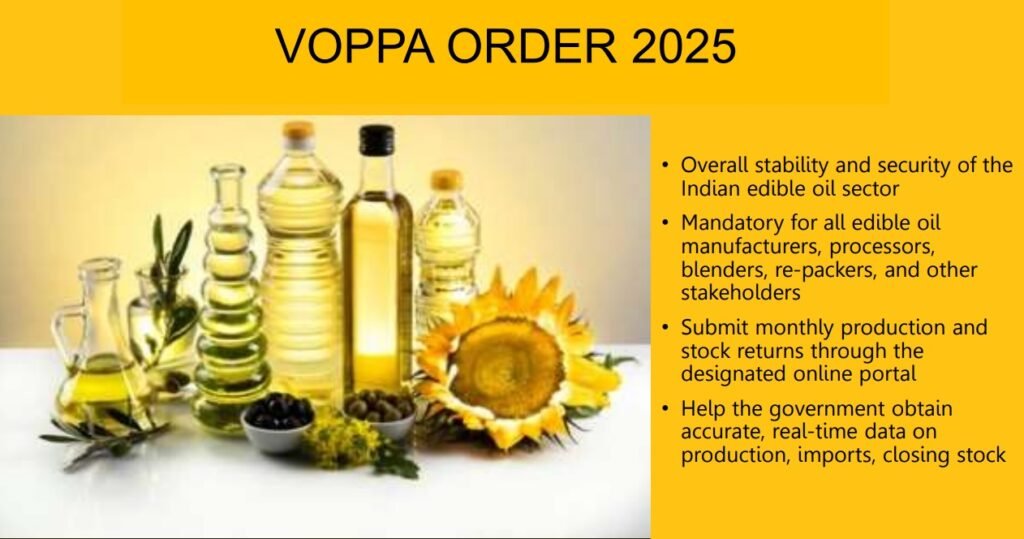
The amended VOPPA Order, 2025, aims to bring greater regulatory oversight and transparency across the edible oil sector in India.
Under the amended order, it is now mandatory for all edible oil manufacturers, processors, blenders, re-packers, and other stakeholders involved in the edible oil supply chain to register under the VOPPA Order and submit monthly production and stock returns through the designated online portal.
According to the department, a significant number of edible oil units across the country have already registered on the National Single Window System portal and are regularly submitting their monthly returns.
The amended order further mentions that non-compliance with the amended VOPPA Order, 2025, will be treated as a violation, and units failing to register or submit their returns will face penal action under the provisions of the amended VOPPA Order and the Collection of Statistics Act, 2008.
According to Manoj Kumar Mishra, Deputy Director, DFPD, GoI, while talking on the sidelines of the recently held 54th AGM of the Solvent Extractors’ Association of India, the amended VOPPA order is not a legal requirement. It is a strategic tool for the government to ensure fair practice, stable supplies and consumer production.
Mishra added that the regulatory changes were needed to align with the evolving market dynamics, institutional shifts and industry needs. These changes were also needed for better data collection, better supply chain management, evidence-based policy formulation and for overall stability and security of the Indian edible oil market.
Promoting fair trade practices

Dr Shilpa Vora, Chief R&D Officer, Marico, opines, “The amended VOPPA Order, 2025, is a timely and progressive reform for the edible oil industry. By introducing mandatory registration and monthly reporting, the order will bring much-needed transparency and enable real-time visibility of production and stock levels across the value chain. This data-driven approach will help ensure better planning, prevent supply imbalances, and strengthen the integrity of market operations. Over time, such initiatives will not only promote fair trade practices and price stability but also enhance consumer confidence in the quality and availability of edible oils in the country. Overall, it marks a positive step towards building a more resilient and accountable ecosystem for the industry.”

Sudhakar Desai, President, The Indian Vegetable Oil Producers’ Association (IVPA), responds by saying, “The primary impact will be enhanced transparency in demand-supply data. While big corporations and the organised sector have already been providing this data to FSSAI and customs on a regular basis, the amendment makes it mandatory for all units, including small players in the unorganised sector. This will help the government obtain accurate, real-time data on production, imports, closing stock, and consumption, enabling data-driven policy interventions in a timely manner.”
Desai goes on to add that the VOPPA amendment doesn’t curb edible oil exports; instead, it strengthens India’s export position by making domestic production, stock, and consumption data more transparent and reliable. Clearer data will boost buyer confidence abroad, giving exporters a competitive edge by showing real production capacity and available surplus. A more consolidated, better-regulated domestic market will help organised exporters meet international demand while preserving fair competition.
Impact on small oil millers
According to industry sources, small oil millers will get a grace period to adjust to the VOPPA amendment’s new mandatory registration and monthly data-upload rules. With hundreds of small, unorganised units versus some 50–60 large players, these mills will need time to learn and adopt the portal. Once in place, the system will give the government reliable data to respond quickly and appropriately to volatile global market shifts. Training sessions have already been held to ease the rollout, and strengthened enforcement will help tidy the market, protecting compliant small millers from unfair competition by unregistered or non-compliant operators.

Shatadru Chattopadhayay, Managing Director, Solidaridad Asia, mentions, “When the VOPPA portal’s data projects a specific domestic shortfall, the government can surgically lower tariffs for just that amount and just for that short period to fill the gap without flooding the market. Secondly, this mechanism effectively acts as a Trojan Horse to combat adulteration. The portal becomes a massive, centralised mass-balance database.
The government can, for the first time, run a simple algorithm across the entire industry. The unintended risks are significant. Industry already worries about a slide back to licence raj and the compliance burden on some 15,000 largely small-scale mills and vanaspati units. Frequent reporting, penalties for discrepancies and intrusive inspections can push smaller, farmer-linked or cooperative units out of business, speed consolidation and weaken local value addition. From an NGO standpoint, transparency is welcome, but the regime must remain proportionate; otherwise, it will undermine inclusive and sustainable edible oil value chains.”
Overseas suppliers
The VOPPA order monitoring is limited to Indian entities—refineries, processors, and importers—because Indian law applies only to domestic operators. However, importers in India will have to report their imported stock, making the government’s visibility indirect. So, while the reform enables partial real-time monitoring of India’s oil supply pipeline, it doesn’t provide comprehensive, real-time oversight of overseas suppliers’ production or storage.
Steven Horton, Founding Shareholder, Enjoi Oil and Foods, “For importers, the VOPPA Order, 2025 won’t necessarily add completely new documents—it will formalise, centralise, and digitalise existing ones, and make reporting mandatory and continuous. It also means that importers selling into the Indian edible oil market will effectively become reporting entities, just like refineries and large domestic traders.

Few Stumbling Blocks
It is most likely that the initial phase will see hundreds of small, unorganised units trying to learn the portal and start uploading monthly data. A positive mindset, along with the government’s training and guidance, should reduce teething problems, and once the routine is established, the process will become straightforward.
Capacity-building Workshops
The Department of Food and Public Distribution, to facilitate effective implementation of the Vegetable Oil Products Production and Availability (Regulation) Order, 2025, has launched a nationwide series of capacity-building workshops across major cities with a significant concentration of edible oil processing units.
The workshop will likely underscore the importance of accurate data filing by the industry as a key driver for nation-building. It will feature interactive demonstrations on registration through the National Single Window System (NSWS) and the VOPPA portal. Besides, the workshop will provide hands-on guidance to industry stakeholders for smooth registration and timely submission of monthly returns under VOPPA 2025.
The outcome
The Department of Food and Public Distribution is wary about the large-scale adulteration, blending, and illegal storage of edible oil. The VOPPA order is a concrete move by the government. Though it may take time to upload certain documents, introducing mandatory registration and monthly reporting will bring much-needed transparency and enable real-time visibility of production.
Sanjiv Das
sanjiv.das@mmactiv.com