
Inside BENEO’s new pulse plant: pioneering sustainable protein from faba beans
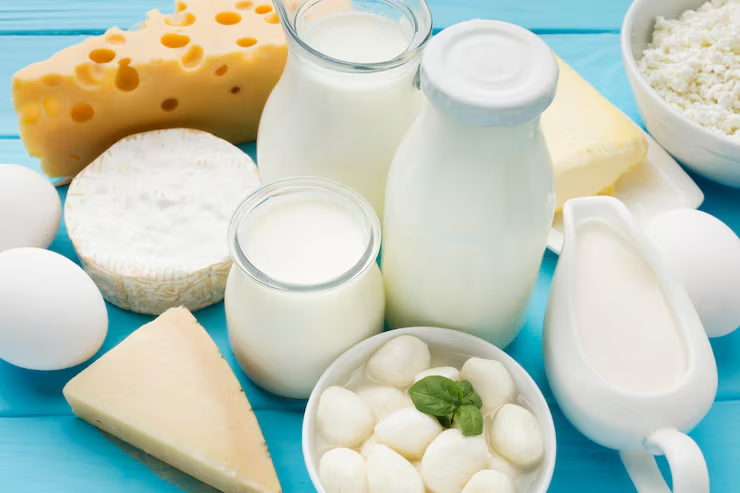
India’s dairy industry is shifting from volume-led growth to margin-driven value creation. As liquid milk’s limits become clear, firms are investing in processing depth, cold chains, and branding to move into higher-margin products like cheese, nutrition, and ingredients. Success now depends on capital allocation and sophistication, not litres collected—transforming milk from a commodity into a scalable, investable asset. This evolution promises stronger returns, export optionality, reduced volatility, and durable competitive moats as consumer wallets expand and global demand for value-added dairy rises.
Across India’s dairy belt, the logic of profit is being quietly rewritten. For decades, success in dairy was measured in litres procured and routes covered. Today, the competitive frontier has shifted to processing depth, packaging sophistication, and brand control. The reward is no longer scale alone, but something far more valuable: structurally higher margins, export optionality, and sustained investor confidence.
For much of independent India’s history, dairy was a volume-first business by design. Cooperatives aggregated milk from millions of smallholders, processors pasteurised it, and distribution networks pushed it into neighbourhood kiranas and mandis. This model underpinned rural livelihoods and national food security, but it was never built to deliver outsized corporate returns. Liquid milk remains capital intensive, operationally fragile, and chronically low-margin. Pricing power is limited, margins are shaped as much by politics as by markets, and procurement volatility is a constant risk.
Over the past decade—accelerating sharply since 2020—a different strategy has taken root. Dairy firms are moving up the value chain, investing in cheese plants, membrane filtration, spray drying, and cold-chain infrastructure. They are entering higher-margin categories such as infant nutrition, whey proteins, speciality cheeses, yoghurts, flavoured beverages, and branded ice creams. This is not a cosmetic portfolio shift, but a balance-sheet transformation—one that improves margins, lifts returns on capital, and dampens earnings volatility. Investors, unsurprisingly, are paying attention.
How Value Addition Rewrites Unit Economics
Value addition in dairy is often discussed as a marketing or portfolio decision. In reality, it represents a fundamental shift in how a single litre of milk is monetised across pricing, logistics, and market access. Processors are not getting paid more because products look premium on shelves, but because value addition changes the economic logic of the business itself. When these forces operate together, they reshape margins, capital efficiency, and investor perception in ways that raw milk volumes never can. “Value-added dairy products are transforming margins, in the range of 30-45 per cent far surpassing liquid milk through premium pricing and advanced processing ,” opined Dr K Rathnam, Whole-time Director and Chief Executive Officer, Milky Mist Dairy Food Limited. “ Our portfolio strategy centres on these high-margin VADPs like ice creams, paneer, cheese and yoghurt categories supported by huge investments in state-of-the-art technologically advanced manufacturing processes, marking our decisive shift from volume-driven to value-focused growth,” he added.
The first shift is higher realisation per litre, driven by reclassifying milk from a finished product into a feedstock. Fresh liquid milk delivers tightly capped realisations, constrained by regulation, political sensitivity, and relentless price competition. Consumer loyalty is shallow, switching costs are negligible, and price hikes invite immediate backlash. Once that same litre is converted into differentiated products—Greek-style curd, probiotic yoghurt, flavoured beverages, processed cheese, butter, ghee, or high-protein ready-to-drink formulations—the revenue extracted from the same milk solids rises sharply. The uplift comes not from volume, but from layered monetisation: functional benefits, usage occasions, packaging convenience, and brand positioning.
In India, where per-capita milk consumption is already high but branded food penetration continues to deepen, even modest per-unit premiums compound rapidly at scale. A processor handling millions of litres a day can unlock hundreds of crores in incremental annual revenue by diverting a relatively small share of milk into higher-realisation categories. Crucially, once consumers anchor on functional or sensory differentiation, price elasticity declines. This allows firms to defend margins even during procurement inflation—a luxury liquid milk rarely affords. It is why sophisticated dairy companies no longer track success in litres sold, but in realisation per kilogram of milk solids.
The second shift lies in shelf-life and logistics arbitrage, an underappreciated but decisive driver of profitability. Fresh milk is among the most operationally unforgiving products in the food system. It demands daily procurement, uninterrupted chilling, rapid distribution, and zero tolerance for disruption. The financial consequences are high wastage risk, compressed working-capital cycles, and elevated logistics intensity. Value-added dairy products fundamentally alter this equation. Milk powders, UHT milk, butter, ghee, and certain cheeses can be stored for months rather than days. Even fresh categories such as yoghurt and curd meaningfully extend sell-by windows.
This flexibility reduces spoilage, allows processors to time sales rather than push daily volumes, and increases revenue per unit of asset utilisation. In India, where cold-chain infrastructure remains uneven beyond major cities, this arbitrage is especially powerful. By converting part of the milk stream into shelf-stable or semi-stable formats, processors can expand geographically without a proportional increase in logistics costs. From a financial standpoint, this improves cash conversion cycles and boosts return on capital employed as working capital locked in daily milk movement is partially released and fixed assets become more productive.
“Remarkable shifts in the approach of dairy companies have taken place. The product basket now contains more protein rich and less sugar variants. Dairies have improved margins by 4-5 per cent by concentrating on value added products, ’’ noted Rahul Kumar, COO, Parag Milk Foods. “Premium products like Protein rich milk , Greek yoghurt and Whey derivatives are on trend and will be growing at good double digit growth. The best part of milk i.e. protein is yet to come as core business of dairies and huge investment in cheese, filtration and customised drying will be in offing”, he added.
The third shift is strategic and often underestimated: Value addition globalises the dairy business. Raw milk is inherently local; fractionated milk solids are international. Once processed into powders, whey proteins, caseinates, lactose, or specialised ingredients, milk becomes part of global supply chains serving infant formula, sports nutrition, bakery, confectionery, beverages, and foodservice. These markets reward specification, consistency, and compliance rather than origin branding. For Indian dairy firms, this opens access to hard-currency revenues and provides a hedge against domestic price controls, demand volatility, and currency risk.
Ingredient markets also allow firms to dynamically allocate milk solids across consumer, institutional, and export channels based on margin optimisation. When domestic demand weakens, exports absorb surplus. When global prices soften, branded domestic products provide stability. Over time, dairy companies evolve from being price takers in local commodity markets into portfolio managers of milk solids, allocating output across channels to maximise risk-adjusted returns.
When these three forces operate together, the outcome is not incremental improvement but a step-change in financial performance. Indian dairy firms with meaningful value-added portfolios consistently report higher and more stable gross margins, EBITDA profiles that are less exposed to procurement cycles, and materially improved returns on capital. Public markets have recognised this divergence clearly. Companies that demonstrate a credible shift toward processed foods, branded dairy, and ingredient platforms trade at meaningfully higher valuation multiples than those dependent on liquid milk volumes alone. The message from investors is unambiguous: litres may create turnover, but value addition creates enterprise value.
Exports and Ingredientisation: Beyond Domestic Wallets
One of the most underappreciated advantages of processing depth is its ability to push the dairy business beyond domestic consumption and into global value chains. This shift—often termed ingredientisation—fundamentally reshapes revenue architecture. When milk is converted into whey protein concentrates, caseinates, lactose, or specialised dairy powders, it ceases to be a politically sensitive staple and becomes an industrial input for global nutrition, foodservice, and pharmaceutical ecosystems. These ingredients are priced not on affordability or volume, but on functionality, purity, and regulatory compliance—attributes that deliver structurally higher margins and greater pricing resilience than liquid milk. “Value-added dairy products are transforming profitability by shifting the industry away from commoditised milk toward high-margin categories. Firms that invest in differentiated offerings—from probiotic beverages to specialty cheeses—are seeing more stable and resilient earnings,” said Shatendra Maurya, Dy General Manager, Verka Faridkot Dairy.
India is already a meaningful exporter of dairy ingredients and milk powders, but the larger opportunity lies ahead. As domestic capacity for advanced spray drying, membrane filtration, and fractionation expands, Indian dairy companies are increasingly positioned to integrate into global supply chains for sports nutrition, clinical nutrition, and infant formula. These are categories driven by demographics, health awareness, and regulation rather than discretionary spending. Buyers prioritise reliability and specification over opportunistic pricing, and contracts are typically denominated in foreign currency, providing a natural hedge against domestic volatility.
Parag Milk Foods offers a clear illustration of this transition. By investing deliberately in whey processing and cheese manufacturing, the company has shifted part of its portfolio into higher-margin ingredient and value-added food segments. Management disclosures consistently point to stronger gross margins from whey and cheese compared to liquid milk, reinforcing a core industry lesson: sustainable profitability flows from processing depth, not procurement scale alone. While not every processor will replicate this trajectory at the same pace, the strategic direction across the industry is increasingly unmistakable.
The Risks Beneath the Upside
Yet value addition and ingredientisation are not without risk. The economics appear compelling on paper, but execution challenges are often underestimated. Processing infrastructure for cheese, powders, and proteins is capital intensive. Spray dryers, fermentation units, and ageing facilities require significant upfront investment, and when capacity is built ahead of demand—or without a clearly defined market—balance sheets can come under pressure. Too often, firms mistake capex intensity for strategic depth and end up asset-heavy but margin-poor.
Product-market fit poses another structural challenge, particularly in a country as diverse as India. Taste preferences, consumption habits, and price sensitivities vary sharply across regions. Products that succeed in metros may fail in tier-2 towns. National rollouts without localisation can lead to inventory stress, write-offs, and brand dilution. Even in export markets, ingredient specifications are exacting; failure to meet functional or regulatory benchmarks can shut doors quickly.
Cost pass-through remains a persistent concern. While processed and branded dairy products offer greater pricing power than fresh milk, they are not immune to spikes in feed, energy, or procurement costs. When inflation rises sharply, margins can compress until repricing catches up, testing cash flows and investor confidence. Regulatory scrutiny adds further complexity. Infant nutrition, clinical nutrition, and specialised dairy ingredients operate under some of the strictest food safety regimes globally. Compliance failures are not merely costly; they can permanently damage credibility in export markets.
Conclusion: The New Metric Is Margin Per Litre
India’s dairy industry stands at a clear inflection point. The old metric—litres collected—is giving way to a more demanding one: margin per litre. Firms that can extract more value from each litre through processing sophistication, packaging intelligence, and route-to-market nuance will build durable economic moats.
The country’s giants—cooperatives like Amul and listed private players such as Parag and Hatsun—are already demonstrating the playbook. For investors scanning the sector, the critical question is no longer whether a company can grow milk volumes, but how intelligently it allocates capital to deepen processing, strengthen cold chains, and build brands that convert milk into margins.
As India’s urban wallets expand and global demand for dairy ingredients continues to rise, value-added dairy is less a tactical pivot than the natural evolution of a maturing industry. The future of Indian dairy will not be decided in milk sheds alone, but in factories, laboratories, boardrooms, and global supply chains—where milk stops being a commodity and starts behaving like capital.
—- Suchetana Choudhury (suchetana.choudhuri@agrospectrumindia.com)