
Inside BENEO’s new pulse plant: pioneering sustainable protein from faba beans
Prateek Rastogi, CEO & Co-Founder, Better Nutrition
The Union Budget 2026 underscored a structural reality facing India’s food and agriculture ecosystem: the rising burden of non-communicable diseases and the need to shift farmer income growth from volume-led production to value-added outcomes.
This observation reflects a deeper transition underway in the sector. Health and agriculture are no longer parallel discussions; they are converging into a single value chain—from soil and seed to consumer health outcomes. However, policy intent alone will not drive transformation. The real inflection point will be defined by how nutrition is embedded into daily consumption patterns at scale, through foods that consumers already eat.
The Persistent Nutrition Gap
Despite growing awareness around healthy eating, micronutrient deficiencies remain widespread across demographic segments in India. Iron deficiency, low zinc intake, poor bone health, and chronic fatigue continue to affect large sections of the population—not due to insufficient food intake, but due to declining nutrient density in staple crops.
Over decades, agricultural systems prioritised yield and efficiency over micronutrient richness. Crop varieties were optimised for productivity rather than mineral density, while soil health gradually deteriorated. As a result, staples such as wheat, rice, and millets today often deliver lower levels of essential micronutrients compared to historical benchmarks.
The industry’s response has largely been downstream intervention—fortification, supplementation, and functional food formulations. While these approaches address immediate gaps, they increase processing complexity and often fail to address bioavailability and long-term sustainability.
The fundamental question, therefore, is not how to add nutrition later, but how to improve the nutritional quality of the grain itself.
Biofortification: A Structural Shift in Nutrition Strategy
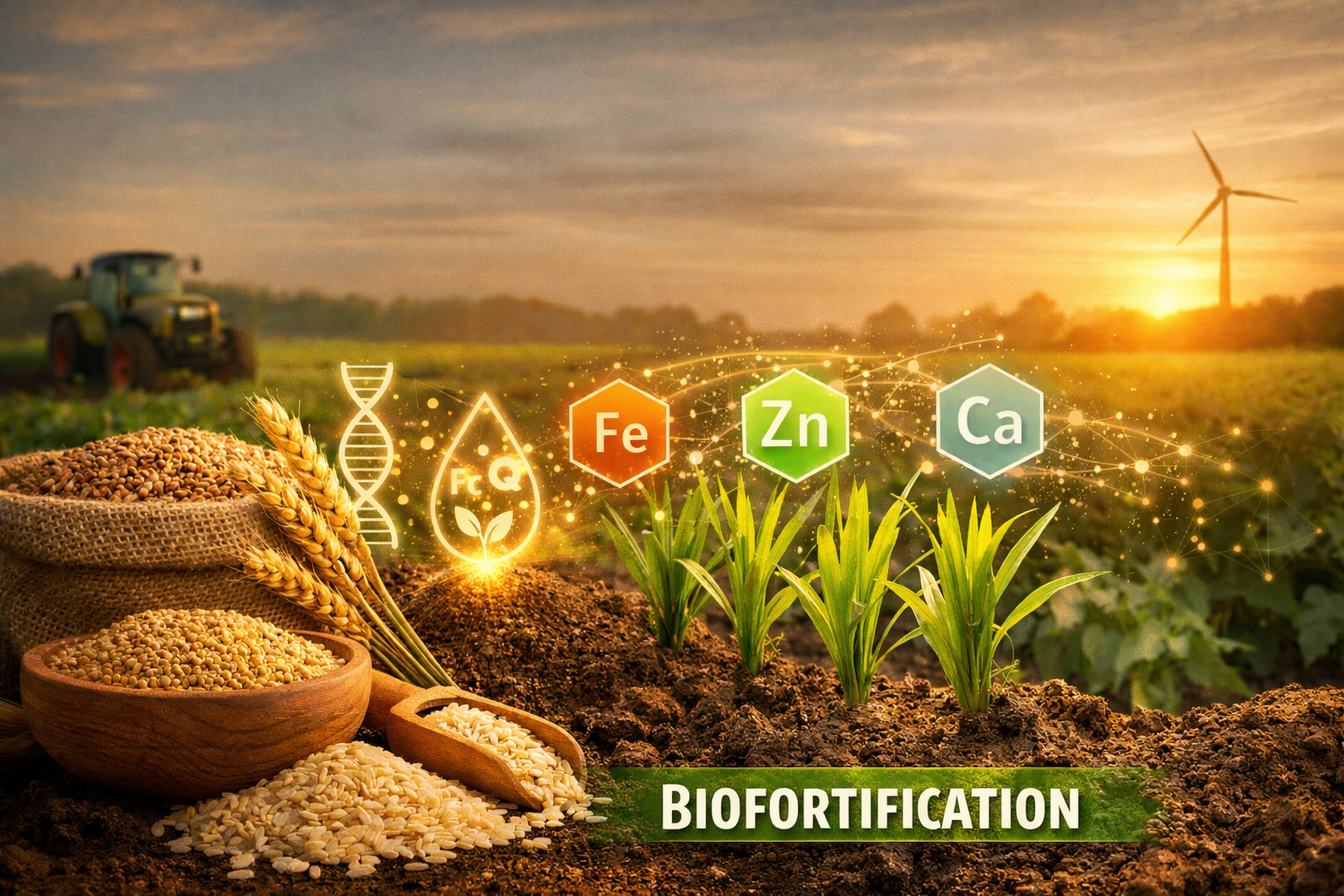
Biofortification represents a paradigm shift by addressing nutrition at the source. By integrating improved seed genetics with enhanced soil practices, crops are developed to naturally absorb and retain higher levels of essential micronutrients such as iron, zinc, calcium, and magnesium.
This approach is not experimental. India already possesses validated biofortified crop varieties developed through sustained research by national and international institutions. What is emerging now is commercial scalability.
For the first time, biofortified staples are being cultivated at scale, systematically tested for nutrient density, and delivered to consumers as mainstream food products rather than niche interventions. This marks a transition from policy-driven nutrition initiatives to market-led execution.
Redefining the ‘Healthy Staples’ Category
Traditionally, the concept of healthy staples has focused on processing attributes—what is removed, refined, or added post-harvest. The next phase of category evolution is defined by intrinsic nutritional value.
A structurally healthier staple is one that:
- originates from crops grown with improved seed and soil practices,
- retains naturally higher micronutrient levels,
- minimises reliance on artificial enrichment, and
- integrates seamlessly into existing consumption habits.
This shift is critical because consumer behaviour in staples is deeply habitual. The market opportunity lies not in changing diets, but in upgrading the nutritional quality of everyday foods without disrupting taste, usage, or affordability.
Trust, Verification, and the Future of Nutrition Claims
One of the most significant gaps in the nutrition ecosystem has been the lack of verifiable transparency. Conventional nutrition labels often rely on static claims, leaving consumers with limited visibility into actual nutrient outcomes.
The industry is now moving towards measurable verification—testing grains for micronutrient content, validating batches, and embedding transparency into staple supply chains. As nutrition becomes quantifiable rather than assumed, trust emerges as a strategic differentiator.
Biofortified foods, therefore, are not only a health innovation but also a credibility-driven category that aligns with evolving regulatory scrutiny and consumer expectations.
From Niche Innovation to Mainstream Adoption
A defining feature of the current phase is accessibility. Biofortified staples are no longer restricted to research pilots or specialised retail channels. Their presence across quick-commerce platforms and modern retail signals a structural shift in market adoption.
Nutrition-led staples are transitioning from niche offerings to mainstream consumption. For consumers seeking healthier everyday foods, biofortified staples represent a pragmatic alternative rather than a premium compromise.
Implications for the Ecosystem
Post–Budget 2026, the opportunity landscape is clear:
- Farmers must be incentivised to optimise for quality alongside yield,
- Brands must invest upstream in crop-level nutrition rather than only downstream formulation, and
- Consumers must be equipped with clarity and evidence rather than proliferating claims.
Embedding nutrition into the grain creates systemic value—enhancing farmer incomes, improving population health outcomes, and reducing long-term healthcare costs.
India’s next nutrition breakthrough will not be driven by incremental product innovation or higher supplementation. It will be anchored in structurally superior staples developed at the agricultural source.
The future of nutrition lies not in what is added later, but in what is cultivated at the beginning of the value chain.