
Inside BENEO’s new pulse plant: pioneering sustainable protein from faba beans
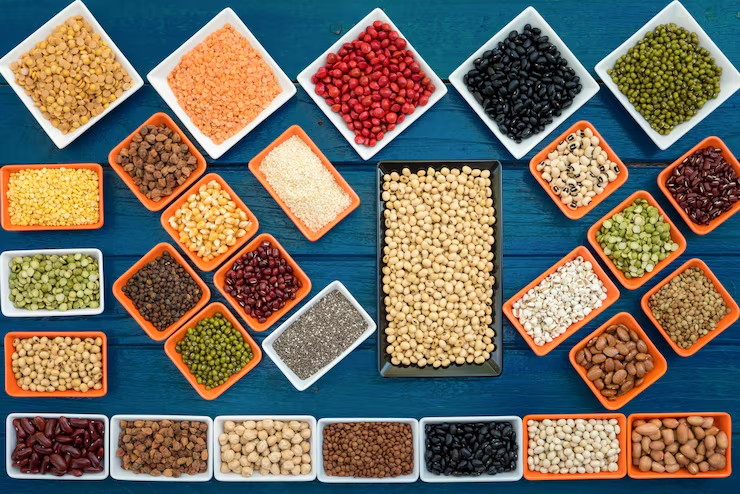
Pulses are undergoing a quiet but profound reinvention. Once viewed as a low-margin staple tied to household kitchens and policy cycles, they are now emerging as strategic building blocks of the modern food system. This shift is being catalysed by rising protein consciousness, time-scarce urban lifestyles, advances in food processing, and a policy framework that prioritises stability over surplus. Together, these forces are transforming pulses from agricultural commodities into scalable, branded ingredients—making this not just a food story, but a structural economic one.
The power of the pulse ingredient economy lies in its structure. Ingredients are repeatable, scalable, and brandable—enabling consistency, expansion, and differentiation beyond price. Most importantly, ingredientisation stabilises demand. When pulses are embedded across snacks, bakery, nutrition, and institutional food, consumption becomes diversified and resilient, no longer tied to household habits or seasonal cycles. In this model, pulses cease to be commodities. They become infrastructure for the modern food system, supporting protein transitions, convenience eating, and health-led consumption at scale.
From Staple to System: Why Pulses Are Changing Now
The reinvention of pulses is neither accidental nor cosmetic. It reflects deep structural shifts in how food is consumed, produced, and valued. Once confined to a low-margin role as a staple, pulses now sit at the intersection of nutrition science, lifestyle change, and industrial food innovation. Three converging forces are driving this transition—elevating pulses from a household necessity to a system-level ingredient.
The first is protein anxiety. As incomes rise, protein has become shorthand for health, strength, and satiety. Yet this demand increasingly collides with discomfort around meat—driven by cost inflation, health concerns, environmental pressure, and ethics. Plant-based protein fills this gap, and pulses are uniquely positioned to lead it. They combine nutritional density, affordability, and cultural familiarity in a way few alternatives can.
What has changed is perception: pulses are shedding the label of “poor man’s protein” and being reframed as clean-label, whole-food nutrition. This shift has unlocked new use cases in sports nutrition, weight management, and medical diets. As protein becomes intentional rather than incidental, pulses move up the value ladder.
The second force is urbanisation—not just of cities, but of time. Traditional pulse consumption assumes patience: soaking, slow cooking, and fresh preparation. In time-scarce, dual-income households, these rituals are increasingly misaligned. Demand has not disappeared; it has shifted. Consumers want pulses without friction—ready-to-cook formats, instant meals, snacks, and versatile ingredients that fit modern routines. Pulses are no longer anchored to meals alone; they are becoming modular inputs across snacks, bakery, breakfast, and beverages.
The third—and most decisive—force is industrial capability. Advances in milling, fractionation, extrusion, and food chemistry now allow pulses to be systematically deconstructed into protein, starch, fibre, and micronutrients, each optimised for function and performance. This rewrites the economics: value is driven by functionality, not volume, and standardisation pushes pulses toward organised, branded ecosystems. In this new landscape, pulses are no longer agricultural outputs. They are food-tech inputs.
The Rise of the Pulse Ingredient Economy
At the heart of this transition lies value addition—a decisive shift in where profits are created and who captures them. For decades, the pulse economy was shaped by upstream arbitrage. Traders extracted value through geography, timing, and information asymmetry. Processing was minimal, differentiation low, and margins volatile. In this system, scale mattered more than strategy. “The growth of the ready-to-eat and quick-cook market is being driven by urban consumers’ desire. Dals today are being used as pulse flours, protein powders and premium snack mixes as health-conscious, value-added items within a higher-margin market. This transition offers a substantial financial opportunity for us to go beyond undifferentiated dals “, mentioned Rohit Mehrotra, Co-Founder, Organic Tattva.
That logic is now breaking down. Value is moving downstream—into processing, formulation, and branding. Pulses are no longer sold merely as crops, but as functional inputs within a broader food ecosystem. This migration is reshaping incentives across the supply chain, rewarding players who can convert raw pulses into consistent, application-specific ingredients.
Pulse flours are the most accessible entry point. Ancient in origin but modern in positioning, lentil, pea, chickpea, and blended pulse flours are marketed as gluten-free, low-GI, protein-rich alternatives to refined wheat. Their use now extends well beyond traditional cuisines into baked goods, snacks, breakfast mixes, and ready-to-cook foods. In order to set themselves apart from conventional, unorganised channels like local dal mills and open-market, organised companies in the pulse sector are using quality, traceability and food safety requirements. Adherence to regulated production lines, stringent lab testing and quality grading, which guarantee constant product integrity are among the organised sector’s main advantages.
“Beyond flours lie protein concentrates and isolates, where margins expand sharply. Pea protein now anchors plant-based meats, dairy alternatives, and nutrition products globally. Despite being a leading pulse producer, India remains underrepresented due to capital intensity and technical complexity, though momentum is building. For Indian processors, protein extraction marks an inflection point—from trading instincts to manufacturing discipline”, added Mehrotra.
“In the pulses category, consumer trust is increasingly shaped by transparency and purity. While unorganised players continue to cater to bulk demand. Bharat Vedica builds credibility through certified organic sourcing, strict quality checks, and clear labelling. As consumers become more mindful of what they eat, they are gravitating towards brands that uphold authenticity, traceability, and consistent standards across the value chain,” opined Arvind Patel, Managing Director, Bharat Vedica – A Patel Venture.
MSP Expansion: De-Risking the Farmer, Stabilising the Crop
The expansion of Minimum Support Price (MSP) procurement for pulses is more than a pricing tool—it is a signal of intent. By procuring key pulses at MSP through agencies such as National Agricultural Cooperative Marketing Federation of India (NAFED) and National Cooperative Consumers’ Federation of India (NCCF), the state has begun absorbing price risk that farmers once bore alone. This matters because pulses compete directly with other crops for acreage. When procurement is credible, cultivation shifts from opportunistic—driven by price spikes—to planned and deliberate.
With downside risk capped, farmers allocate land more confidently, invest in better inputs, and adopt improved practices. The result is structural: lower volatility, steadier output, and more predictable supply. And for modern food markets, predictability matters more than volume.
Stability in the pulses sector is further strengthened by the Mission for Aatmanirbharta in Pulses, which reimagines pulses not merely as agricultural output but as strategic economic assets. Moving beyond earlier policies that focused primarily on production volumes, the mission adopts a comprehensive value-chain approach—integrating output targets with improved seed development, access to quality planting material, assured procurement, and, crucially, investments in post-harvest processing, storage, and infrastructure. By stabilising farmer incomes through enhanced MSP and higher procurement volumes, government policies are already reshaping the domestic pulses market. These efforts gain further momentum from the newly approved National Pulses Mission, which aims to boost domestic production while ensuring robust market linkages, including 100 per cent MSP procurement of key pulses. As Mehrotra notes, by reducing price volatility and ensuring reliable raw material availability for processors, this policy framework is fostering long-term supply stability across the sector.
The shift is subtle but decisive. Production alone does not create resilience or value. What matters is how output is aggregated, processed, stored, and channelled into markets. By promoting processing capacity, modern storage, and cluster-based development, the mission enables pulses to move reliably into organised, specification-driven supply chains, while nudging the sector toward standardisation—an essential requirement for ingredient manufacturers and branded food companies.
For organised players, this policy-driven stability is not a bonus; it is a precondition. Processing plants, protein extraction units, and branded food businesses are capital-intensive and long-term by nature. They cannot operate on erratic supply or sudden price shocks. Every investment decision—from plant location to product design—rests on predictable access to raw material at consistent quality.
By reducing production risk and improving supply visibility, policy lowers the cost of capital. Banks lend more readily. Investors commit with greater confidence. Scale becomes feasible. In effect, policy is doing what markets alone could not: crowding in investment by reducing uncertainty.
The deeper shift is philosophical. Pulse policy now recognises that farmer welfare and market development are interdependent. MSP and missions are no longer just support mechanisms; they are market-enabling instruments, integrating farmers into modern value chains. For pulses, this alignment is the foundation of the next phase of the economy.
What Still Holds Pulses Back
Despite growing momentum, India’s shift from pulse staple to pulse system remains unfinished and uneven. Structural constraints—some legacy, some newly exposed—continue to slow the transition.
The most immediate bottleneck lies post-harvest. Pulses suffer high losses due to inadequate drying, poor storage, pest damage, and fragmented logistics. More moisture- and insect-sensitive than cereals, they have long been underserved by storage infrastructure. For an ingredient economy built on consistency, these losses undermine reliability, not just efficiency.
Processing is the second constraint. While dal milling is widespread, advanced capacity for fractionation, protein extraction, and functional ingredients remains limited. Most facilities are small-scale and volume-driven, ill-suited to specification-led output. Scaling requires capital, technical expertise, energy efficiency, and demand visibility—still evolving.
Demand-side gaps persist as well. Consumer understanding of pulse-based ingredients remains shallow, limiting repeat adoption beyond “high-protein” cues.
Most consequentially, India has yet to emerge as a major exporter of high-value pulse ingredients. The challenge is not supply, but conversion—turning abundance into export-ready, globally compliant ingredients. These constraints are solvable, but explain why progress has been incremental rather than explosive.
Conclusion: Pulses as the Future, Not the Past
Pulses have always fed India. What is new—and consequential—is the ambition to make them power growth. For decades, pulses occupied a paradoxical place in the food economy: indispensable yet undervalued, nutritionally rich yet economically fragile. As commodities, they were trapped in cycles of volatility, weak differentiation, and episodic policy attention. Their value was cultural and nutritional—not commercial.
That paradigm is now shifting. As ingredients, pulses acquire a new identity. They become modular, versatile, and investable—capable of moving across food categories, consumption occasions, and markets. They align with the logic of modern food systems, where value is created through functionality, consistency, and brand equity rather than volume alone.
The transition from dal to derivatives—from staple to system—reshapes how agricultural value is created, captured, and sustained in India. It offers an exit from the low-margin commodity trap and a pathway toward a more resilient, innovation-led agri-food economy.
This transformation is not driven by any single force. It is the result of convergence—rising protein demand, changing lifestyles, advancing food technology, and policy increasingly oriented toward market creation. Dal will always matter. But the future of pulses will be written elsewhere—in processing plants, ingredient labs, branded portfolios, and global value chains. Beyond the bowl lies the real opportunity.
— Suchetana Choudhury (suchetana.choudhuri@agrospectrumindia.com)